


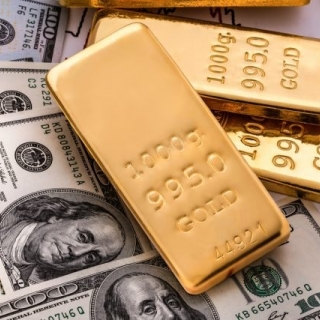
Gold fell as the dollar jumped after President-elect Donald Trump threatened 25% tariffs on imports from Canada and Mexico.
Trump said the import duties were needed to curb migrants and illegal drugs flowing across the U.S. border, while also vowing to impose additional 10% tariffs on Chinese goods. A stronger dollar dented bullion's appeal by making it more expensive for many buyers.
Bullion traded near $2,620 an ounce after dropping 3.4% in the previous session as easing tensions in the Middle East sapped demand for safe-haven assets. Israel's security cabinet is expected to vote on a cease-fire agreement with Lebanon's Hezbollah on Tuesday, and its ratification is considered likely, an Israeli official said.
The precious metal is still up more than 25% this year, supported by central bank buying and the Federal Reserve's shift to interest rate cuts. Many analysts remain positive on the outlook, with Goldman Sachs Group Inc. and UBS sees further gains in 2025.
"Investors are increasingly pricing in an American ‘Golden Age' with pro-market — and pro-crypto — cabinet choices while the U.S. debt and deficit story is being pushed out," said Nicky Shiels, Geneva-based head of metals strategy at MKS PAMP SA. "Gold needs to get back to $2,500, not $3,000, in the short term."
Spot gold fell 0.1% to $2,621.45 an ounce by 8:29 a.m. in Singapore after dropping as much as 0.8% earlier.
The Bloomberg Dollar Spot Index rose 0.5%, after dropping 0.5% in the previous session. Silver, platinum and palladium all fell slightly.
Investors are now focused on the Fed's interest rate meeting next month, with several reports this week that could provide clues about the decision. The data include the central bank's November meeting minutes, consumer confidence and personal consumption expenditures data, the monetary authority's preferred measure of inflation.
Source: Bloomberg
Gold prices weakened slightly on Thursday (February 12th), as more solid US employment data reduced market confidence in an imminent Federal Reserve interest rate cut. The strong employment data promp...
Gold prices strengthened on Wednesday, supported by a weaker US dollar and falling US bond yields after the latest economic data reinforced the narrative that the Federal Reserve is likely to continue...
Gold experienced a slight correction in the European session on Tuesday (February 10th), but remained above $5,000/oz as the market held its breath ahead of a series of US data that could alter intere...
Gold held above the psychological $5,000 level at the start of the week, supported by a combination of factors that are "right" for the precious metal : physical demand from China, expectations of low...
Gold prices are still struggling to turn an intraday rebound into a sustained rally. After briefly falling to $4,654 (a four day low) and rebounding, prices were again rejected near $4,900. In the Eur...
Oil prices stabilized on Thursday (February 12th), as the market reassigned a risk premium to US-Iran tensions despite US inventory data showing swelling domestic supplies. This movement confirms one thing: geopolitical headlines are still more...
Gold prices weakened slightly on Thursday (February 12th), as more solid US employment data reduced market confidence in an imminent Federal Reserve interest rate cut. The strong employment data prompted market participants to shift expectations of...
The Hang Seng Index reversed its downward trend in Hong Kong on Thursday (February 12th), weakening by around 0.9% to around 27,000 after a strong session earlier. This decline halted the momentum of the short term rally, as investors began to...